The journal · Pregnancy
The Glucose Test in Pregnancy: The Orange Drink, the Hour of Waiting, and What the Result Means
In short
The glucose test in pregnancy screens for gestational diabetes — diabetes that shows up only during pregnancy — and most people have it between 24 and 28 weeks. The first test is short and does not require fasting: you drink a sweet glucose drink, wait an hour, and give one blood sample. If that number comes back at roughly 135 to 140 mg/dL or higher, you go back for a longer test that involves fasting overnight and several blood draws, and that longer test is the one that actually diagnoses or rules out gestational diabetes. A high first result is a reason to look closer, not a diagnosis. Gestational diabetes affects 5% to 9% of U.S. pregnancies and is usually managed with food, activity, and blood sugar checks — sometimes with medication.
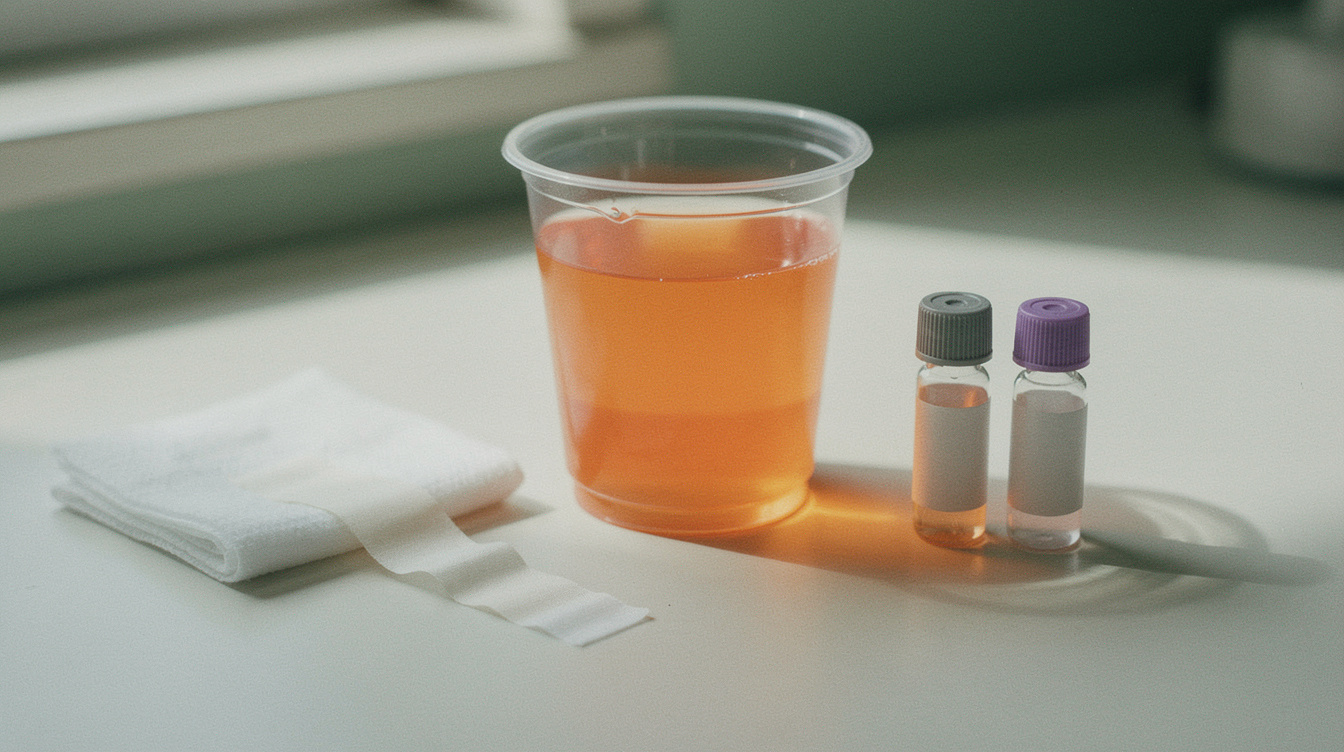
Somewhere around the middle of pregnancy, someone hands you a cup of very sweet orange liquid, tells you to finish it, and asks you to sit in a waiting room for an hour. Nobody explains much. You drink it, you wait, you get your arm poked, you go home — and then you spend the next two days wondering what happens if the number is wrong.
This is the glucose test, and it is one of the most routine appointments in pregnancy. It is also one of the most quietly stressful, mostly because the parts that would make it less stressful — how long it takes, whether you can eat first, what a high number actually means — usually go unsaid. Here is all of it, with every clinical claim traced to a source you can click and read yourself.
01What the glucose test is looking for
The test screens for gestational diabetes — in the words of the National Institute of Diabetes and Digestive and Kidney Diseases (NIDDK, part of the National Institutes of Health), "a type of diabetes that occurs only during pregnancy." Pregnancy changes how your body handles sugar. The CDC explains that hormonal changes and weight gain during pregnancy make the body more resistant to insulin — the hormone that moves sugar out of your blood and into your cells — so your body needs more of it than usual. When it cannot keep up, blood sugar rises.
It is common. "Every year, 5% to 9% of U.S. pregnancies are affected by gestational diabetes," according to the CDC, which also notes that it "usually develops around the 24th week of pregnancy."
And here is the reason a screening test exists at all: you cannot feel it. Gestational diabetes "often has no symptoms, or they may be mild, such as being thirstier than normal or having to urinate more often," per NIDDK. MedlinePlus makes the same point — it "doesn't usually cause symptoms in the early stages." There is nothing to notice, so the test does the noticing for you.
02When you'll have it
Between 24 and 28 weeks. NIDDK says doctors test for gestational diabetes "between 24 and 28 weeks of pregnancy," the CDC says "you'll probably be tested between 24 and 28 weeks," and MedlinePlus agrees you will "most likely be screened for the condition between 24 and 28 weeks of pregnancy." Three separate federal health sources, one window.
Some people get tested earlier. If you have a higher risk of gestational diabetes, your provider may screen you sooner in the pregnancy. The CDC lists these as things that raise the risk:
- Having had gestational diabetes in a previous pregnancy
- Having previously given birth to a baby who weighed more than 9 pounds
- Being overweight
- A family history of type 2 diabetes
- Polycystic ovary syndrome (PCOS), a hormone condition that affects the ovaries
- Being African American, Hispanic or Latino, American Indian, Alaska Native, Native Hawaiian, or Pacific Islander
If one or more of those apply to you, it is worth asking at an early prenatal visit when your provider plans to test — not because anything is wrong, but because knowing the date beats being surprised by the orange drink. Our pregnancy checklist lays out the rest of the appointments and screenings in the order they usually come.
03The one-hour test: what actually happens
The first test is the short one. It is called a glucose challenge test, and the single most useful thing to know about it is that you do not have to fast. NIDDK is explicit: "You do not need to fast for this test." MedlinePlus says the same. Eat breakfast.
The one-hour glucose challenge test, start to finish
- Eat normally beforehand. No fasting is required for the screening test (NIDDK).
- Drink the glucose drink. You "drink a sweet liquid containing glucose" (NIDDK). The Cleveland Clinic describes the taste as "extra sweet Gatorade or flat soda, which may taste unpleasant for some people."
- Wait one hour. That is the whole middle of the test. Plan for it the way the Cleveland Clinic suggests for glucose testing generally: "bring something (like a book) to entertain yourself while you wait."
- Give one blood sample. "A blood sample is taken one hour later" — a single draw, not a series (MedlinePlus).
- Then you go home. There is nothing else to do and no recovery to speak of. MedlinePlus notes there is "very little risk to having a blood test" beyond "slight pain or bruising at the spot where the needle was put in."
- Expect to maybe feel off. Of glucose testing, the Cleveland Clinic says "some people say it makes them feel nauseated or dizzy, but serious side effects are rare." If you are someone who gets lightheaded after blood draws, say so before the needle, not after.
The result is one number. If it comes back at roughly 135 to 140 mg/dL or higher, NIDDK says "you may need to return for an oral glucose tolerance test" — the longer one. (mg/dL means milligrams per deciliter, the unit U.S. labs use for blood sugar. The exact cutoff your clinic uses may sit anywhere in that range.)
A high one-hour result is not a diagnosis
This is the part worth hearing twice, because it is the part that ruins a weekend. The one-hour test is a screen, not a diagnosis — it is deliberately set to catch more people than actually have gestational diabetes, so that nobody gets missed. As the Cleveland Clinic puts it, if the one-hour screening result is abnormal, your provider will recommend the three-hour test "to officially diagnose or rule out the condition." Rule out is right there in the sentence. A phone call asking you to come back for the longer test means the system is working exactly as designed.
04The three-hour test: the longer one
The follow-up is the oral glucose tolerance test, and it asks more of you. For this one you do fast: NIDDK says "you will need to fast for at least 8 hours" beforehand, which in practice means an early-morning appointment and nothing but water after dinner. The Cleveland Clinic adds a prep step most people have never heard: "Eat as you normally do for at least three days before the test. You should consume at least 150 grams of carbohydrates each day." Cutting carbs to try to pass the test can distort the result — it is not a test you can study for.
At the lab you drink a glucose solution again — the Cleveland Clinic describes a typical dose as "75 grams of glucose dissolved in 250 to 300 mL of water" — and then the draws begin. NIDDK says "blood will be drawn every hour for 2 to 3 hours"; MedlinePlus says that in pregnancy you will "have your blood drawn every 30 minutes for two to three hours." Your clinic's schedule will be one of those. You stay on site the whole time, and you are not eating or smoking during the test, per the Cleveland Clinic.
What makes a diagnosis is the pattern, not one bad number. If your blood sugar is "high two or more times during the OGTT, you may have gestational diabetes," per NIDDK.
How to make three hours in a waiting room survivable
- Take the earliest appointment you can get, so the overnight fast is mostly sleep.
- Bring water — it is the one thing the fast allows (Cleveland Clinic).
- Bring food for afterward, and plan to eat the moment the last draw is done.
- Bring a book, headphones, or anything else to pass the time, and arrange a ride if blood draws tend to leave you shaky.
- Ask at check-in whether the draws are every 30 or every 60 minutes, so you know how many are coming.
05If you do have gestational diabetes
The first thing to know is that this is a managed condition, not an emergency, and most of the management is ordinary daily life. NIDDK describes treatment as "following a healthy eating plan and being physically active," adding that if those are not enough, "you may need insulin." The CDC frames it the same way — blood sugar monitoring, physical activity, and healthy eating — and notes that "if healthy eating and being active aren't enough to manage your blood sugar, your doctor may prescribe insulin, metformin, or other medication."
Needing medication is not a personal failure. Insulin resistance in pregnancy is driven by the pregnancy itself, which is also why the condition typically ends with it: "most of the time, gestational diabetes goes away after giving birth," per MedlinePlus. What the plan for your pregnancy looks like — how often you check your blood sugar, what the targets are, whether you need medication — is a conversation with your own provider, not something any article can set for you.
06What it can mean for the baby
The CDC says plainly that gestational diabetes can cause health problems for mother and baby, which is the whole reason for screening a condition you cannot feel. The clearest picture of the newborn side comes from the MedlinePlus medical encyclopedia, which covers babies born to mothers with diabetes.
- Low blood sugar in the first days. A baby "is more likely to have periods of low blood sugar (hypoglycemia) shortly after birth, and during the first few days of life" — because "the baby has been used to getting more sugar than needed from the mother" and has "a higher insulin level than needed after birth."
- A bigger baby. Babies of mothers with diabetes "are often larger than other babies, especially if diabetes is not well-controlled."
- Breathing and jaundice. They are more likely to have "breathing difficulty due to less mature lungs" and a "high bilirubin level (newborn jaundice)," which is treated with light therapy.
The care that follows is practical and happens right there in the room. "The baby's blood sugar will be checked within the first hour or two after birth, and rechecked regularly until it is consistently normal," per the same source, and "feeding soon after birth may prevent low blood sugar in mild cases." If feeding is not enough, low blood sugar "is treated with fluid containing sugar (glucose) and water given through a vein (IV)." So expect a heel prick or two in the first hours, and expect the staff to want your baby fed early. If jaundice comes up, our guide to newborn jaundice walks through what light therapy involves and what the numbers mean.
07After the birth: the part people forget
Gestational diabetes usually resolves with the pregnancy, but it leaves a flag on your chart that is worth paying attention to. "About half of women with gestational diabetes go on to develop type 2 diabetes," says the CDC, which advises: "Talk to your doctor about how to lower your risk. Ask how often to have your blood sugar checked to make sure you're on track." MedlinePlus puts it the same way — you "will be at higher risk for developing type 2 diabetes in the future."
NIDDK adds that a child born after a gestational diabetes pregnancy "is more likely to have obesity or develop type 2 diabetes," and that being physically active before and during pregnancy — and reaching a healthier weight before a future pregnancy if you are overweight — lowers the risk of gestational diabetes next time.
The practical version: before you leave your last prenatal appointment, ask when you should be retested after the baby comes, and write the answer down. That one question in a calm moment is worth more than any amount of worrying in the waiting room, and it is exactly the kind of thing that disappears in the first weeks home unless someone wrote it on a list.
This is general information, not medical advice
Blood sugar targets, cutoffs, whether you are screened early, and what treatment you need are all decisions for your own OB, midwife, or primary care provider — they know your history and this page does not. Nothing here should change a plan your provider has given you. If you have questions about your result, call the office that ordered the test; sorting out a number over the phone takes five minutes and is a completely normal thing to ask for.
08One appointment, off your mind
Most of the dread around the glucose test comes from not knowing its shape: one hour, no fasting, one needle, and a follow-up test that exists to rule things out as often as to rule them in. Knowing that in advance turns it from an ominous milestone into an errand.
That is the whole idea behind this site. Pregnancy is a hundred small tasks and appointments with a hard deadline and no obvious order, and the ones that catch people off guard are usually the ones nobody described in advance. Enter your due date and you'll get a free, personalized week-by-week plan with the important things placed early — including the window when this test lands. Our second trimester checklist covers what else belongs in these same weeks.
Questions parents actually ask
Do I have to fast for the glucose test in pregnancy?
Not for the first one. NIDDK and MedlinePlus both state that you do not need to fast for the one-hour glucose challenge test — you can eat normally, drink the glucose drink, and have a single blood sample taken an hour later. The longer three-hour oral glucose tolerance test is different: NIDDK says you will need to fast for at least 8 hours before that one.
When is the glucose test done in pregnancy?
Usually between 24 and 28 weeks. NIDDK, the CDC, and MedlinePlus all describe that window. If you have a higher risk of gestational diabetes — for example a previous gestational diabetes pregnancy, a previous baby over 9 pounds, PCOS, or a family history of type 2 diabetes — your provider may screen you earlier, so it is worth asking at an early visit.
What happens if I fail the one-hour glucose test?
You go back for the three-hour test, and that is a normal next step rather than a diagnosis. NIDDK says a screening result of roughly 135 to 140 mg/dL or higher means you may need to return for an oral glucose tolerance test, and the Cleveland Clinic describes that longer test as the one used to officially diagnose or rule out gestational diabetes. The one-hour screen is set deliberately wide so nobody is missed.
How long does the three-hour glucose test take, and what happens during it?
You fast for at least 8 hours, drink a glucose solution at the lab, and then give blood repeatedly while you wait. NIDDK describes blood being drawn every hour for two to three hours; MedlinePlus describes draws every 30 minutes for two to three hours in pregnancy. You stay on site the whole time and do not eat during the test, so bring something to do and food for afterward. A diagnosis rests on the pattern: NIDDK says if your blood sugar is high two or more times during the test, you may have gestational diabetes.
Does the glucose drink make you sick?
It can make you feel off, but serious problems are rare. The Cleveland Clinic says the drink tastes like extra sweet Gatorade or flat soda and that some people feel nauseated or dizzy, while serious side effects are rare. MedlinePlus notes there is very little risk to the blood test itself beyond slight pain or bruising where the needle went in.
Does gestational diabetes go away after the baby is born?
Usually. MedlinePlus says most of the time gestational diabetes goes away after giving birth. But the CDC notes that about half of women who had gestational diabetes go on to develop type 2 diabetes, and advises talking with your doctor about lowering that risk and how often to have your blood sugar checked. Ask for that follow-up plan before you leave your last prenatal appointment.
Sources
- CDC — Gestational Diabetes — 5% to 9% of U.S. pregnancies are affected by gestational diabetes; it usually develops around the 24th week and you'll probably be tested between 24 and 28 weeks; hormonal changes and weight gain cause insulin resistance so the body needs more insulin; risk factors (previous gestational diabetes, previous baby over 9 pounds, overweight, family history of type 2 diabetes, PCOS, listed racial and ethnic groups); treatment is blood sugar monitoring, physical activity, and healthy eating, with insulin, metformin, or other medication if those are not enough; gestational diabetes can cause health problems in both mother and baby; about half of women with gestational diabetes go on to develop type 2 diabetes, and to ask the doctor how often to have blood sugar checked.
- NIDDK (National Institutes of Health) — Gestational Diabetes — Gestational diabetes is a type of diabetes that occurs only during pregnancy; doctors test for it between 24 and 28 weeks; it often has no symptoms or mild ones such as extra thirst or urinating more often; it is caused by hormonal changes that make the body less able to use insulin, with genes and extra weight possibly playing a role; the tests used are the glucose challenge test and the oral glucose tolerance test; treatment is a healthy eating plan and physical activity, with insulin if needed; higher later risk of type 2 diabetes for the mother and of obesity or type 2 diabetes for the child; physical activity before and during pregnancy and losing extra weight before pregnancy lower the risk.
- NIDDK (National Institutes of Health) — Diabetes Tests & Diagnosis — No fasting is needed for the glucose challenge test; you drink a sweet liquid containing glucose and blood is taken 1 hour later; a result of 135 mg/dL to 140 mg/dL or higher means you may need to return for an oral glucose tolerance test; for the OGTT you must fast at least 8 hours and drink a liquid high in sugar, with blood drawn every hour for 2 to 3 hours; blood sugar high two or more times during the OGTT may mean gestational diabetes.
- MedlinePlus (National Library of Medicine) — Diabetes Tests — Screening most likely happens between 24 and 28 weeks of pregnancy; you drink a sugary liquid containing glucose and a blood sample is taken one hour later with no fasting required; during pregnancy the oral glucose tolerance test involves blood drawn every 30 minutes for two to three hours; gestational diabetes doesn't usually cause symptoms in the early stages; most of the time it goes away after giving birth but leaves a higher risk of type 2 diabetes; there is very little risk to a blood test beyond slight pain or bruising.
- MedlinePlus Medical Encyclopedia — Infant of a diabetic mother — Babies are more likely to have periods of low blood sugar shortly after birth and during the first few days of life, because the baby was used to getting more sugar than needed from the mother and has a higher insulin level after birth; babies are often larger, especially if diabetes is not well controlled; higher chance of breathing difficulty from less mature lungs and of newborn jaundice treated with light therapy; the baby's blood sugar is checked within the first hour or two after birth and rechecked regularly; feeding soon after birth may prevent low blood sugar in mild cases, and low blood sugar that does not improve with feeding is treated with glucose and water through an IV.
- Cleveland Clinic — Glucose Tolerance Test — Eat normally for at least three days before the test with at least 150 grams of carbohydrates a day; fast, taking nothing but water, for usually at least eight hours right before; a typical dose is 75 grams of glucose dissolved in 250 to 300 mL of water; the drink tastes like extra sweet Gatorade or flat soda; you stay at the hospital or medical building until the end of the test, so bring something to entertain yourself; do not eat or smoke during the test; some people feel nauseated or dizzy but serious side effects are rare; a one-hour glucose challenge test in pregnancy is a routine screen, and an abnormal result leads to a three-hour test to officially diagnose or rule out the condition.
Newborn Weeks is planning help, not medical advice — always follow your own doctor, midwife, or pediatrician.
From the gear guide
- Hauck Sport Travel Stroller — our pick in travel strollers
- Mompush Wiz 2-in-1 Stroller — our pick in travel strollers
- Bright Starts Playful Paradise Swing — our pick in bouncers & swings
- Dr. Brown's Folding Drying Rack — our pick in sterilizers & drying racks
Keep reading
 Sleep · 13 min read
Newborn Day-Night Confusion: Why Your Baby Is Up All Night (and What Actually Helps)
Newborn day-night confusion is a body clock that isn't built yet. What the AAP and sleep research say actually helps, and when it ends on its own.
Read the article Feeding · 14 min read
Baby Won't Take a Bottle? What Actually Helps, Step by Step
Baby won't take a bottle? The AAP-, La Leche League- and CDC-backed fixes that help: who offers it, when, how warm the milk is, and when to call the doctor.
Read the article Pregnancy · 13 min read
The Tdap Vaccine in Pregnancy: Why It's Given at 27 to 36 Weeks
The Tdap vaccine in pregnancy is given at 27 to 36 weeks so antibodies reach your baby before birth. What the CDC says about timing and safety.
Read the article