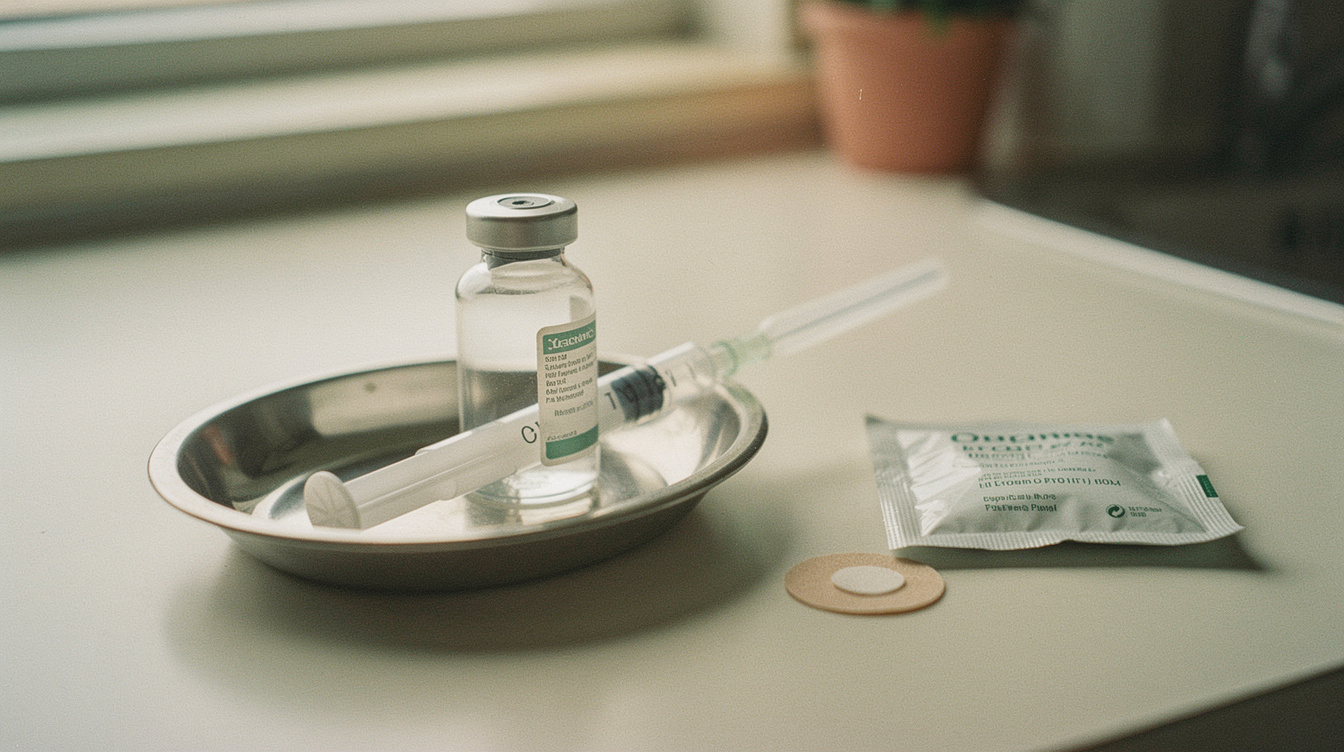
The journal · Pregnancy
The Tdap Vaccine in Pregnancy: Why It's Given at 27 to 36 Weeks
In short
Tdap protects against tetanus, diphtheria and pertussis — whooping cough — and the CDC recommends one dose during the 27th through 36th week of every pregnancy, preferably early in that window. The point is not really to protect you. Your body makes antibodies and passes high levels of them to your baby before birth, which covers the stretch before your baby is old enough for their own whooping cough shots. Given in the third trimester, it prevents 78 percent of whooping cough cases in babies under two months old and is 91 percent effective against the cases that land a baby in the hospital. It is recommended in every pregnancy, even if your last one was a year ago.
Somewhere in the third trimester, at an otherwise ordinary appointment, someone will offer you a shot in the arm and call it Tdap. It takes about ninety seconds, your arm aches for a day, and it is easy to file it alongside the blood pressure cuff and the urine cup as one more thing that happened at a prenatal visit.
It is worth more attention than that. Of everything on the third-trimester list, this is the one that hands your baby a protection they cannot build for themselves for another couple of months. Here is what the shot is, why it is scheduled where it is, how well it actually works, and what the CDC says about safety — with nothing filled in by guesswork.
This is general information, not medical advice
Every pregnancy is different, and vaccine timing is a conversation for your own OB, midwife, or family doctor — they know your history, your due date, and what else you are due for. If you have had a reaction to a vaccine before, or you are not sure what you have already received, that is exactly the kind of thing to raise at your next visit rather than sort out on your own.
01What Tdap is, and what it actually does
Tdap is one shot covering three things: tetanus, diphtheria, and pertussis. Pertussis is the one that matters most here — it is the bacterial infection almost everyone knows by its older name, whooping cough.
The reason it is offered in pregnancy is not mainly about you. According to the CDC, after the shot "a pregnant woman's body creates protective antibodies and passes high levels of them to the baby before birth," giving your baby "some short-term protection against whooping cough in early life." Clinicians call that passive immunity — the antibodies are borrowed from you rather than made by your baby, the way a loaned coat keeps someone warm before they own one. The CDC's provider guidance describes maternal Tdap as something that "provides passive immunity to the infant" and also helps keep a parent from passing whooping cough to a newborn in the first place.
That borrowed protection is the whole design. It is meant to cover the weeks when your baby is most vulnerable and has nothing of their own yet.
02The timing: weeks 27 through 36, and earlier in that window is better
The CDC recommends Tdap be given during the "27th through 36th week" of each pregnancy, "preferably during the earlier part of this time period." Its vaccine recommendations page says the same thing in one sentence: "CDC recommends giving a single dose of Tdap during every pregnancy, preferably during the early part of gestational weeks 27 through 36."
So if you are counting weeks, week 27 to roughly week 30 is the sweet spot rather than week 35. Earlier in the window leaves more time for your body to produce antibodies and send them across to your baby before the birthday arrives — which also means it is worth bringing up yourself at the visit around week 27 rather than waiting to be offered it.
Past week 36? It is not a missed boat
The window is a preference, not a cutoff. The CDC's guidelines for vaccinating pregnant women say Tdap is recommended "between 27 and 36 weeks of gestation although Tdap may be given at any time" in pregnancy. If you are at 38 weeks and nobody has mentioned it, ask — there is still a reason to give it.
03Every pregnancy, even if your last one was a year ago
This is the part that surprises most second- and third-time parents. A Tdap dose from a previous pregnancy does not carry over to this baby. The CDC is explicit that "vaccination in every pregnancy offers best protection" because protective antibodies decrease over time — and that this holds "even if pregnancies are only a year or two apart."
The CDC's vaccination guidelines put the instruction to providers plainly: "administer a dose of Tdap during each pregnancy irrespective of the patient's prior history." And the provider page explains why in one line — "vaccination during each pregnancy is important for transferring the greatest number of protective antibodies to each infant." Each baby gets their own set. You cannot split one dose between siblings.
04How well it works
These are the numbers worth knowing, and they are unusually good for a single shot.
- It prevents most cases in the youngest babies. Tdap given in the third trimester "prevents 78% of pertussis cases in infants younger than 2 months of age," per the CDC — the parent-facing version of the same figure is that it "prevents more than 3 in 4 cases" in babies under two months.
- It is better still at preventing the serious ones. The same CDC page puts it at "91% effective against hospitalized cases." Written for parents, that reads: it "protected 9 in 10 babies" from infections serious enough to need hospital care.
- It is not a force field. Seventy-eight percent is not one hundred, and the protection is short-term by design. It covers the early stretch before your baby's own whooping cough series takes over, not the whole first year.
That last point is why the shot is one piece of a plan rather than the entire plan. Your baby's own immunizations pick up where the borrowed antibodies fade — our guide to the newborn vaccine schedule walks through what arrives when in that first year.
05Why whooping cough is different for a newborn
Most adults who get whooping cough describe weeks of a terrible cough. In a newborn, the illness does not necessarily look like that at all, and that is precisely what makes it dangerous.
The CDC states it directly: "Many babies with whooping cough don't cough at all. Instead, they may have apnea (life-threatening pauses in breathing)." Those pauses may make a baby "turn blue" or struggle to breathe. In other words, the warning sign a parent would be watching for — the cough — can simply be absent.
The same CDC page gives the scale of it: "About 1 in 3 babies younger than 1 year old who get whooping cough need care in the hospital." Among babies under a year who are hospitalized, it lists apnea in 68 percent, pneumonia in 22 percent, convulsions in 2 percent, and encephalopathy — brain inflammation — in 0.6 percent, and notes that "one in 100 (1%) will die from their complications."
We are not putting those numbers here to frighten anyone at 30 weeks pregnant. They are the reason the recommendation is as firm as it is, and the reason the two no-cost things on this page — your own shot, and asking the adults around your baby about theirs — are worth doing rather than meaning to do.
06Is it safe in pregnancy?
The CDC says plainly: "Tdap is very safe for pregnant women and their babies." The FDA has "approved both Tdap vaccines (Boostrix and Adacel) for use during pregnancy," and no safety concerns have been identified.
Behind that sentence sit the monitoring systems. The CDC's provider page reports that "to date, VAERS has not found any safety signals among pregnant women or their babies after Tdap vaccination" — VAERS being the national system where anyone, including parents, can report a problem after a vaccine. The CDC's vaccination guidelines summarize the safety data as showing nothing that would "suggest any elevated frequency or unusual patterns of adverse events in pregnant women." MotherToBaby, the pregnancy exposure information service, says the same of the published research: it "has not found an increased risk for problems in pregnancy or for the newborn."
As for how it feels, the CDC lists the common side effects as pain, redness, and swelling where the needle went in, and says "severe side effects are extremely rare." One practical note from that: a sore arm is the usual outcome, so if you are a side sleeper in the third trimester, consider which arm you would rather not sleep on.
07If it did not happen during pregnancy
This one is commonly misunderstood, including by well-meaning relatives, so it is worth getting right. The CDC's pertussis vaccine recommendations state that CDC "only recommends Tdap in the immediate postpartum period for women who've never received Tdap, including during adolescence or adulthood." If you have had a Tdap dose at some point in your life but missed one this pregnancy, that guidance does not call for a dose right after delivery.
Which is to say: whether you need a postpartum dose depends on your own vaccination record, not on a rule of thumb. Ask your provider to check, and ask before discharge if you can — it is a thirty-second question at a moment when nobody has slept.
08The adults who will be holding the baby
Your Tdap dose covers your baby from the inside. The other half of the job is the ring of people who will be breathing near that baby in the first weeks, because whooping cough travels between people who are simply close together.
MotherToBaby describes the approach by its usual name: "'Cocooning' refers to the vaccination of those who will be in close contact with the baby (dad, siblings, grandparents, and caretakers) in order to reduce the chance baby will be exposed to pertussis." It recommends those contacts be vaccinated at least two weeks before they are around the baby.
Two weeks is the operative detail, and it is why this is a third-trimester task rather than a hospital-parking-lot one. If your mother is flying in the week the baby is born, the conversation has to happen now. We put the broader version of this — who visits, when, and what to ask of them — in our guide to newborn visitor rules, which is the page to forward when asking feels awkward.
09The other shots that land in the same few weeks
Tdap is usually not the only vaccine on the third-trimester agenda, and the timing of the others is different, which is where confusion creeps in. From the CDC's guidelines for vaccinating pregnant women:
- Flu. Pregnant women should receive an inactivated or recombinant flu vaccine, and it "can be administered at any time during pregnancy, during the influenza season." The CDC notes pregnancy brings a "higher risk for severe illness and complications from influenza." No special week to wait for.
- RSV. The guidelines recommend one dose of the Pfizer RSV vaccine (Abrysvo) at "gestational weeks 32-36 administered between September and January," and specify that it is the only RSV vaccine that may be given in pregnancy. Note the narrower window and the seasonal condition — this one genuinely depends on when your due date falls.
- Tdap. Weeks 27 through 36, every pregnancy, as above.
Which of these applies to you, and in what order, is your provider's call at your visits. The rest of the third-trimester runway — the tests, the bag, the car seat, the pediatrician — is laid out in our third trimester checklist.
10Ninety seconds, early in week 27
Almost nothing else on a third-trimester to-do list has this shape: one brief, well-studied thing that measurably lowers the odds of your newborn being hospitalized. The work is remembering to bring it up early in the window instead of late, and asking the people who will hold your baby to sort out their own.
If the rest of the list is the part that feels unmanageable, that is the problem we built this site to solve. Enter your due date and you will get a free, personalized week-by-week plan — with this shot sitting where it belongs, in the week you can actually do something about it.
Questions parents actually ask
When should I get the Tdap vaccine during pregnancy?
The CDC recommends one dose during the 27th through 36th week of pregnancy, preferably during the earlier part of that window — so closer to week 27 than week 36. Earlier in the window leaves more time for antibodies to build and reach your baby before birth. If you are already past week 36, the CDC's vaccination guidelines note Tdap may be given at any time in pregnancy, so it is still worth asking.
Do I need Tdap again if I had it in my last pregnancy?
Yes. The CDC says vaccination in every pregnancy offers the best protection because protective antibodies decrease over time, and that this holds even if pregnancies are only a year or two apart. Its instruction to providers is to give a dose during each pregnancy irrespective of the patient's prior history — each baby needs their own set of borrowed antibodies.
How well does the Tdap vaccine in pregnancy protect my baby?
According to the CDC, Tdap given in the third trimester prevents 78 percent of whooping cough cases in babies younger than two months old, and is 91 percent effective against cases serious enough to require hospitalization. Written for parents, the CDC describes that as preventing more than 3 in 4 cases and protecting 9 in 10 babies from infections needing hospital care.
Is the Tdap vaccine safe during pregnancy?
The CDC states that Tdap is very safe for pregnant women and their babies, and that the FDA has approved both Tdap vaccines — Boostrix and Adacel — for use during pregnancy. The national reporting system VAERS has not found any safety signals among pregnant women or their babies after Tdap vaccination. The usual side effects are pain, redness, and swelling at the injection site, and the CDC says severe side effects are extremely rare.
Should my partner, parents, and other visitors get Tdap too?
It is worth asking them. MotherToBaby describes cocooning — vaccinating the people who will be in close contact with the baby, including a partner, siblings, grandparents, and other caregivers — to reduce the chance the baby is exposed to whooping cough, and recommends they be vaccinated at least two weeks before they are around the baby. That two-week lead time is why the conversation belongs in the third trimester, not at the hospital.
What if I did not get Tdap during pregnancy — do I get it right after delivery?
It depends on your own record. The CDC only recommends a Tdap dose in the immediate postpartum period for people who have never received Tdap, including during adolescence or adulthood. If you have had Tdap at some point before, that guidance does not call for a dose after delivery. Ask your provider to check your record rather than assuming either way.
Sources
- CDC — Tdap Vaccination During Pregnancy — Tdap recommended during the 27th through 36th week of each pregnancy, preferably during the earlier part of that period; vaccination in every pregnancy offers best protection because antibodies decrease over time, even if pregnancies are only a year or two apart; the pregnant woman's body creates protective antibodies and passes high levels of them to the baby before birth, giving some short-term protection in early life; prevents more than 3 in 4 cases of whooping cough in babies under 2 months and protected 9 in 10 babies from serious infections requiring hospitalization; Tdap is very safe for pregnant women and their babies; FDA approved both Boostrix and Adacel for use during pregnancy; side effects are mostly pain, redness and swelling at the injection site, with severe side effects extremely rare.
- CDC — Vaccinating Pregnant Patients (Pertussis) — Optimal timing is between 27 and 36 weeks gestation, preferably during the earlier part of that period; vaccination during each pregnancy is important for transferring the greatest number of protective antibodies to each infant; maternal Tdap provides passive immunity to the infant and helps protect against transmitting pertussis to the newborn; third-trimester Tdap prevents 78% of pertussis cases in infants younger than 2 months and is 91% effective against hospitalized cases; VAERS has not found any safety signals among pregnant women or their babies after Tdap vaccination.
- CDC — Guidelines for Vaccinating Pregnant Women — Administer a dose of Tdap during each pregnancy irrespective of the patient's prior history; recommended between 27 and 36 weeks of gestation although Tdap may be given at any time; safety data do not suggest any elevated frequency or unusual patterns of adverse events in pregnant women; inactivated or recombinant influenza vaccine can be administered at any time during pregnancy during influenza season, and pregnancy carries higher risk for severe illness from influenza; one dose of the Pfizer RSV vaccine (Abrysvo) at gestational weeks 32-36 administered between September and January, and only Abrysvo may be given to pregnant women.
- CDC — Pertussis Vaccine Recommendations — CDC recommends a single dose of Tdap during every pregnancy, preferably during the early part of gestational weeks 27 through 36; CDC only recommends Tdap in the immediate postpartum period for women who have never received Tdap, including during adolescence or adulthood.
- CDC — Whooping Cough Signs and Symptoms — Many babies with whooping cough do not cough at all and instead may have apnea, life-threatening pauses in breathing, which can make them turn blue or struggle to breathe; about 1 in 3 babies younger than 1 year old who get whooping cough need hospital care; among hospitalized babies under 1, apnea occurs in 68%, pneumonia in 22%, convulsions in 2% and encephalopathy in 0.6%, and 1 in 100 will die from their complications.
- MotherToBaby — How You Can Protect Your Baby from Pertussis Before and After Birth — Optimal time to give Tdap is between 27-36 weeks gestation; cocooning means vaccinating those who will be in close contact with the baby — partner, siblings, grandparents and caretakers — to reduce the chance the baby is exposed to pertussis; those contacts should be vaccinated at least two weeks before contact with the infant; published information on pertussis vaccination in pregnancy has not found an increased risk for problems in pregnancy or for the newborn.
Newborn Weeks is planning help, not medical advice — always follow your own doctor, midwife, or pediatrician.
From the gear guide
- Kolcraft Cloud Plus Umbrella Stroller — our pick in travel strollers
- Graco Gomax Frame Stroller — our pick in travel strollers
- MINKINH 26-Piece Manicure Set — our pick in nail care & grooming
- Baby Trend Snap N Go EX — our pick in infant car seats
Keep reading
 Sleep · 13 min read
Newborn Day-Night Confusion: Why Your Baby Is Up All Night (and What Actually Helps)
Newborn day-night confusion is a body clock that isn't built yet. What the AAP and sleep research say actually helps, and when it ends on its own.
Read the article Feeding · 14 min read
Baby Won't Take a Bottle? What Actually Helps, Step by Step
Baby won't take a bottle? The AAP-, La Leche League- and CDC-backed fixes that help: who offers it, when, how warm the milk is, and when to call the doctor.
Read the article Pregnancy · 14 min read
The Glucose Test in Pregnancy: The Orange Drink, the Hour of Waiting, and What the Result Means
What the glucose test in pregnancy is really like: when it happens, whether you fast, how long it takes, and what a high result does and doesn't mean.
Read the article