The journal · Pregnancy
Group B Strep in Pregnancy: The 36-Week Swab, Explained
In short
Group B strep (GBS) is an ordinary bacterium that lives in a lot of healthy bodies — about 1 in 4 people test positive in pregnancy. You get swabbed at around 36 to 37 weeks, and a positive result is not an infection and not something you did. It simply means you get antibiotics through an IV once labor starts, which works best when they go in at least four hours before delivery. With those antibiotics, the Cleveland Clinic puts a baby's chance of GBS infection at roughly 1 in 4,000, versus about 1 in 200 without them. Treating it earlier in pregnancy does not help, because the bacteria grow back.
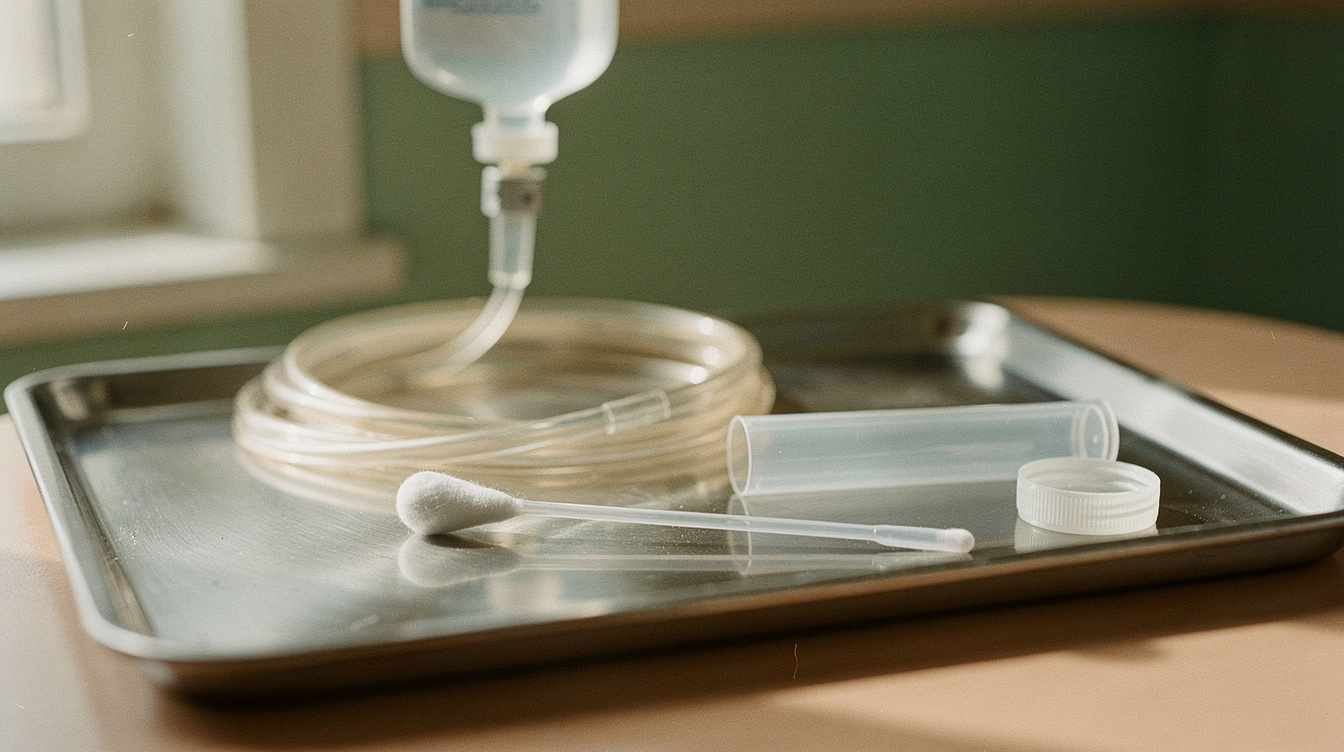
At some point around 36 weeks, a nurse will swab you in two slightly undignified places, and a day or two later someone will call and say you are "GBS positive." If nobody explained it first, that phone call lands like bad news. It usually is not.
Group B strep is one of the most common things you will be tested for in pregnancy and one of the least well explained. Here is the whole thing in plain language — what the bacteria is, what the swab is for, what a positive result actually changes about your labor, and the handful of newborn symptoms worth knowing either way. Every clinical claim below is linked to the page it came from.
This is general information, not medical advice
Your own OB or midwife knows your history, your allergies, and your hospital's protocol — so anything here about testing, antibiotics, or symptoms is worth raising with them directly. If you are worried about your baby at any point, call your pediatrician instead of reading. That is exactly what they are there for.
01What group B strep actually is
Group B strep — GBS, or group B Streptococcus — is a bacterium, not an illness. The Cleveland Clinic describes it as "a type of bacteria that typically lives in your vagina, intestines and rectum," and the CDC notes that these bacteria "commonly live in people's gastrointestinal and genital tracts." It is not a sexually transmitted infection, and it is not a sign that anything is unclean.
It is also, for the adult carrying it, usually a non-event: "Most adults don't have symptoms of group B strep," per the Cleveland Clinic. And it is common. About 1 in 4 females test positive during pregnancy, the same source says — which is worth repeating to yourself if the phone call rattled you. One in four.
The crucial distinction, and the one that gets lost: carrying GBS is not having an infection. The American Academy of Pediatrics puts it directly — a positive test "only means that you have these bacteria in your body. Testing positive for GBS does not mean that you have an infection."
02Why anyone bothers testing for it
Because the one group that GBS can genuinely hurt is a brand-new baby. "Pregnant women can pass the bacteria to their babies during delivery," the CDC says, and "most babies who get GBS disease in the first week of life are exposed to the bacteria this way."
When it does cause illness in a newborn, it is serious. The AAP says GBS "is responsible for many cases of meningitis, an inflammation of the membranes surrounding the brain and spinal cord, in infants, as well as some cases of blood infections (sepsis) and pneumonia."
That is the reason for a swab that takes under a minute. The test is not looking for something wrong with you. It is sorting out which labors get an IV antibiotic and which do not.
03The test: one swab, around 36 to 37 weeks
The AAP's advice to expectant parents is to get the test "at 36–37 weeks pregnant," and the Cleveland Clinic gives the same window — "between 36 and 37 weeks of pregnancy." Here is what the appointment involves.
- It is a swab, not a blood draw. The AAP describes it as "an easy swab of the vagina and rectum that should not hurt." The Cleveland Clinic adds that a provider uses "a cotton swab to obtain samples of cells from your vagina and rectum. This test doesn't hurt and takes less than a minute."
- Results come back fast. Most people have them "within 48 hours," per the Cleveland Clinic — it is a lab culture, so the wait is the bacteria growing, not a queue.
- You get tested every pregnancy. "Each time you are pregnant, you need to be tested for GBS," the AAP says. A negative result last time tells you nothing about this time, and neither does a positive one.
- There is nothing to do to prepare, and nothing you can do to change it. GBS comes and goes on its own. A result is a snapshot of that week, which is exactly why the swab is taken so close to your due date.
One honest wrinkle you may notice while reading around: patient pages do not all give the same week. The AAP's testing page and the Cleveland Clinic both say 36 to 37 weeks, while an older AAP page on GBS infections still says "between 35 to 37 weeks of every pregnancy." The newer number is 36 to 37. Either way, this is your provider's calendar item, not yours — but if you are at 37 weeks and nobody has swabbed you, it is a completely fair thing to ask about. Our third-trimester checklist has it in the list with everything else that belongs in those weeks.
04If you test positive: antibiotics in labor
A positive result changes one thing about your birth: you get an antibiotic through an IV once labor is underway. "The most common antibiotic to treat group B strep is penicillin or ampicillin," says the Cleveland Clinic, and it is given through the vein — the AAP specifies "intravenous (never by mouth) antibiotics when they are giving birth, typically when labor begins."
Timing is the part worth knowing in advance. The antibiotics "work best if you get them at least 4 hours before you deliver," per the AAP; the Cleveland Clinic says the same, that they are most effective "when given at least four hours before delivery." So if your provider sounds keen for you to come in promptly once labor starts rather than riding it out at home, that four-hour window is usually why — ask them what they want you to do.
Why they won't just treat it now and be done
This is the question almost everyone asks, and the answer is simply that it does not work. "It's not effective to treat GBS before labor begins," the Cleveland Clinic says, and the AAP explains that antibiotics are given during labor rather than beforehand because "the bacteria can grow back very fast." Clearing GBS at 36 weeks would leave you re-colonized well before the birth — and you would have taken the antibiotics for nothing. One exception the Cleveland Clinic notes: if GBS turns up in your urine, "oral antibiotic treatment begins right away (regardless of the stage of pregnancy)," because that is an actual infection rather than carriage.
Two more specifics people ask about. On a planned cesarean, the Cleveland Clinic's answer is "No, you don't need antibiotics if you're having a C-section delivery" — your own team will confirm what applies to your birth, particularly if labor starts or your water breaks first. And if you are allergic to penicillin, say so early and specifically, because the alternative antibiotic has to be chosen for you; none of the sources here prescribe one, and your provider will. It is worth writing both the GBS result and the allergy into whatever you bring to the hospital.
05The numbers, plainly
Nobody tells you the actual odds, which makes GBS feel bigger than it is. The Cleveland Clinic gives them: without antibiotics in labor, roughly 1 in 200 babies born to a GBS-positive parent gets GBS; with antibiotics, that falls to about 1 in 4,000.
Read it the other way around and it is the most reassuring thing on this page. Even with no treatment at all, the overwhelming majority of babies are fine — and the IV in your arm makes an already-unlikely thing about twenty times less likely. That is the entire reason the swab exists.
06Three things that raise the risk
The CDC lists these as factors that increase a newborn's chance of GBS disease:
- "Testing positive for GBS bacteria late in pregnancy"
- "Developing a fever during labor"
- "Having 18 hours or more pass between water breaking and baby's birth"
Notice that two of the three are things your labor team is already watching for and already has a plan for — a temperature and a clock. This is not a list for you to police. It is the list that explains why they take your temperature so often and why they ask exactly when your water broke.
07Early-onset and late-onset: the difference that matters
GBS illness in babies comes in two forms, and they are not prevented the same way. The AAP splits them like this: early-onset disease occurs "within the first week of life," where babies contract GBS from their mothers before or during birth, while late-onset happens "after a week of age, and through the first 3 months of life" and the bacteria can come from the mother, other children, family members, or other caregivers.
Antibiotics in labor are aimed squarely at the early kind. The later kind they cannot touch — and the CDC is blunt that "experts haven't identified effective ways to prevent GBS disease in people older than one week," and that "there are currently no vaccines to prevent GBS disease, but they are under development."
So the practical takeaway is not more worry. It is that knowing the symptoms is useful for every parent, GBS-positive or not — because the version of this illness that nobody can prevent is the version you catch by noticing.
08What to watch for in a newborn
The CDC notes that "most newborns who get GBS disease in the first week of life have symptoms on the day of birth" — while you are still surrounded by staff. The symptoms it lists:
Call your pediatrician right away about any of these
- "Fever"
- "Difficulty feeding"
- "Irritability or lethargy (limpness or baby is hard to wake up)"
- "Difficulty breathing"
- "Blue-ish color to skin"
A fever in a newborn is its own emergency regardless of GBS — our guide to a newborn fever and when to call covers the thresholds and how to take a temperature properly. And if a baby does get GBS, it is treatable: the AAP says newborns with GBS infections "should be treated with intravenous antibiotics such as ampicillin, gentamicin, penicillin, or another antibiotic such as a cephalosporin."
For most positive results, though, nothing extra happens to the baby at all. The AAP notes that after you have had antibiotics in labor, "the baby likely won't need extra antibiotics or other medicine after birth, unless the doctor tells you that they are needed."
09What to actually do about it
There is remarkably little on your side of this, which is the good news. The short version:
Your GBS to-do list
- Have the swab done at 36 to 37 weeks — and ask about it if you hit 37 weeks and it has not happened.
- Ask what your result was, and write it down. "Positive," "negative," or "unknown" all change what happens in labor.
- Tell them about a penicillin allergy now, not in labor. The alternative antibiotic is their choice to make, and it is easier made in a quiet office.
- Ask whether GBS has ever shown up in your urine during this pregnancy, since the Cleveland Clinic notes that is handled differently and right away.
- Ask what they want you to do when labor starts, given that the antibiotics work best at least four hours before delivery.
- Put the result where someone will find it — with your ID and insurance card in the hospital bag, not only in your own head.
That is it. Group B strep is a good example of the kind of thing that feels enormous at 36 weeks and turns out to be a bag of fluid on a pole for a few hours. The rest of the third trimester has a handful of items like this — small, time-sensitive, easy to miss in the shuffle. Our free week-by-week planner lays them out in the order they actually come due, so the 36-week swab is on a list somewhere other than your memory.
Questions parents actually ask
When do you get tested for group B strep in pregnancy?
At around 36 to 37 weeks. The AAP advises getting the GBS test at 36-37 weeks pregnant, and the Cleveland Clinic gives the same window. You will still see some older patient pages, including one from the AAP, saying 35 to 37 weeks. It is a swab of the vagina and rectum that takes under a minute, and results usually come back within 48 hours.
What does it mean to be GBS positive?
It means the bacteria are living in your body — not that you are sick. The AAP is explicit that a positive test "only means that you have these bacteria in your body" and "does not mean that you have an infection." It is also common: the Cleveland Clinic says about 1 in 4 females test positive during pregnancy. The practical consequence is an IV antibiotic once labor starts.
Why can't I just take antibiotics now instead of during labor?
Because they would not still be working by the time you give birth. The Cleveland Clinic says it is not effective to treat GBS before labor begins, and the AAP explains that antibiotics are given during labor because the bacteria can grow back very fast. The exception is GBS found in your urine, which the Cleveland Clinic says is treated with oral antibiotics right away, at any stage of pregnancy.
How much does the antibiotic actually help?
A lot, from an already low baseline. The Cleveland Clinic puts the risk at roughly 1 in 200 babies without antibiotics in labor, and about 1 in 4,000 with them. Both the AAP and the Cleveland Clinic note the antibiotics work best when given at least four hours before delivery.
Does being GBS positive mean I need a C-section?
No. In every source used for this article, the prevention plan for a GBS-positive pregnancy is an intravenous antibiotic during labor — not a different kind of delivery. On the other side of that question, the Cleveland Clinic says you do not need the antibiotics if you are having a C-section delivery. Confirm what applies to your own birth with your provider, especially if labor or your water breaking comes first.
What are the signs of group B strep in a newborn?
The CDC lists fever, difficulty feeding, irritability or lethargy (limpness, or a baby who is hard to wake), difficulty breathing, and a blue-ish color to the skin. Most newborns who get GBS disease in the first week have symptoms on the day of birth. Any of these warrant a call to your pediatrician right away, and a fever in a newborn is urgent on its own.
Sources
- Cleveland Clinic — Group B Strep — GBS is a bacterium that typically lives in the vagina, intestines, and rectum; most adults have no symptoms; about 1 in 4 females test positive during pregnancy; screening between 36 and 37 weeks; a cotton swab of the vagina and rectum that does not hurt and takes less than a minute; results within 48 hours; penicillin or ampicillin are the most common antibiotics; most effective when given at least four hours before delivery; it is not effective to treat GBS before labor begins; GBS in the urine is treated with oral antibiotics right away at any stage; antibiotics are not needed for a C-section delivery; risk of about 1 in 200 babies without antibiotics versus about 1 in 4,000 with them; newborn symptoms.
- HealthyChildren.org (AAP) — Pregnant Moms: Get Tested for Group B Strep — Get the GBS test at 36-37 weeks pregnant; it is an easy swab of the vagina and rectum that should not hurt; a positive result only means the bacteria are present and does not mean you have an infection; IV antibiotics during delivery work best if given at least 4 hours before you deliver; antibiotics are given during labor rather than earlier because the bacteria can grow back very fast; you need to be tested each time you are pregnant; the baby likely will not need extra antibiotics or medicine after birth unless the doctor says so.
- HealthyChildren.org (AAP) — Group B Streptococcal Infections — GBS is responsible for many cases of meningitis in infants as well as some cases of sepsis and pneumonia; early-onset disease occurs within the first week of life from exposure before or during birth; late-onset occurs after a week of age through the first 3 months and can come from the mother, other children, family members, or caregivers; prevention by intravenous (never oral) antibiotics when giving birth, typically when labor begins; this page still states testing between 35 to 37 weeks of every pregnancy; infected newborns are treated with IV antibiotics such as ampicillin, gentamicin, penicillin, or a cephalosporin; symptoms include fever, feeding difficulties, irritability, and lethargy.
- CDC — About Group B Strep Disease — GBS bacteria commonly live in people's gastrointestinal and genital tracts; pregnant women can pass the bacteria to their babies during delivery and most babies who get GBS disease in the first week of life are exposed this way; providers should screen all pregnant women for GBS; get antibiotics during labor if needed; there are currently no vaccines to prevent GBS disease, but they are under development; experts have not identified effective ways to prevent GBS disease in people older than one week.
- CDC — Symptoms of Group B Strep Disease — Newborn symptoms in the first week of life: fever, difficulty feeding, irritability or lethargy (limpness or baby is hard to wake up), difficulty breathing, and blue-ish color to skin; most newborns who get GBS disease in the first week of life have symptoms on the day of birth.
- CDC — Risk Factors for Group B Strep Disease — Factors that increase a newborn's risk of GBS disease: testing positive for GBS bacteria late in pregnancy; developing a fever during labor; having 18 hours or more pass between water breaking and the baby's birth.
Newborn Weeks is planning help, not medical advice — always follow your own doctor, midwife, or pediatrician.
From the gear guide
- Elvie Stride — our pick in breast pumps
- Willow Go — our pick in breast pumps
- BlueSnail Stretchy Changing Pad Cover 2pk — our pick in diaper bags & changing pads
- Comfy Cubs Easy Swaddle Blanket — our pick in swaddle & receiving blankets
Keep reading
 Sleep · 13 min read
Newborn Day-Night Confusion: Why Your Baby Is Up All Night (and What Actually Helps)
Newborn day-night confusion is a body clock that isn't built yet. What the AAP and sleep research say actually helps, and when it ends on its own.
Read the article Feeding · 14 min read
Baby Won't Take a Bottle? What Actually Helps, Step by Step
Baby won't take a bottle? The AAP-, La Leche League- and CDC-backed fixes that help: who offers it, when, how warm the milk is, and when to call the doctor.
Read the article Pregnancy · 13 min read
The Tdap Vaccine in Pregnancy: Why It's Given at 27 to 36 Weeks
The Tdap vaccine in pregnancy is given at 27 to 36 weeks so antibodies reach your baby before birth. What the CDC says about timing and safety.
Read the article