The journal · Postpartum
Postpartum Constipation: The First Poop After Birth, and What Actually Helps
In short
Postpartum constipation is extremely common — one study-based review puts it at nearly 42% by women's own report. After a vaginal birth the first bowel movement often comes in the first day or two; after a C-section it can take three or four days. Water, fiber, gentle walking, and a stool softener are the standard first moves, and they are what the discharge instructions from the National Library of Medicine actually recommend. The evidence on laxatives for preventing it is thin, and the one reassuring finding for nursing parents is that a laxative you take appears to have little or no effect on your baby's stools. If you have stitches or hemorrhoids, keeping stools soft is the whole game — and anything that is still wrong at six weeks is a conversation with your provider, not something to wait out.
Almost nobody warns you about this one. You have just had a baby, you are sore in places you did not know could be sore, and somewhere in the first few days a quiet dread arrives: at some point, you are going to have to poop.
It is one of the most common things new parents are anxious about and one of the least discussed. So here is the honest version — how common postpartum constipation really is, when the first bowel movement usually turns up, what the research says about laxatives (less than you would hope), and the small, unglamorous habits that genuinely make it easier. Every clinical claim below links to the source it came from.
This is general information, not medical advice
Every birth and every recovery is different. Anything here about medications, stool softeners, stitches, or symptoms is worth running past your own OB, midwife, or family doctor — they know your history, your delivery, and what you are already taking. If something feels wrong between visits, call them. That is exactly what they are there for.
01How common it is — and how long it can last
Common enough that you are closer to the rule than the exception. The Cochrane review Interventions for preventing postpartum constipation reports that "the prevalence of postpartum constipation was reported to be 41.8% by self-report and 24.7% as classified by the Rome criteria" — the Rome criteria being the formal clinical definition doctors use, which is stricter than how it feels to the person living it.
It also does not always clear up in a week. The same review notes that "25% of women suffer from constipation throughout pregnancy and at three months postpartum," and that "having two or fewer bowel movements a week is thought to occur in one third of women in their third trimester." In other words: if this started while you were pregnant and is still going a few months after the birth, you are in large and ordinary company — and it is still worth mentioning to your provider rather than simply enduring.
02When the first bowel movement usually comes
This is the question people actually want answered, and the timing depends a lot on how you delivered.
- After a vaginal birth. Cleveland Clinic says that "with a vaginal delivery, it may not be very delayed. You may poop in that first day or two after delivery."
- After a C-section. Expect longer. "Sometimes, after a C-section, the bowels can take some time to wake up since you've just gone through a major surgery," the same article explains. "It can take three or four days for your first poop after delivery."
A surgical recovery has its own timeline for nearly everything, bowels included — our C-section recovery guide covers the rest of it, and the postpartum recovery timeline walks through what the first six weeks tend to look like either way.
03Why it happens
There is rarely one cause. Usually it is several ordinary things stacking up at once, and most of them are temporary.
- Pain medication. Cleveland Clinic lists pain medication containing opioids as a common contributor — constipation is one of the best-known effects of that class of drug.
- Iron supplements. Also on Cleveland Clinic's list: iron taken after blood loss at delivery, which is a frequent and very normal prescription.
- Dehydration from breastfeeding. Nursing pulls fluid out of you faster than most people replace it, which Cleveland Clinic names as a third driver.
- Pregnancy itself. The Cochrane review's background points to high progesterone levels during pregnancy, combined with interruptions to normal eating, as part of why the system is already sluggish before the birth even happens.
- Pain, and the fear of pain. The same review lists hemorrhoids causing fear of pain while going, plus pain from an episiotomy or other perineal injury, among the risk factors — along with ignoring the urge when it comes.
- Less moving around. Reduced physical activity after delivery and a low-fiber diet both appear on the review's list of contributing factors. Neither is a character flaw at one week postpartum; both are fixable.
04What actually helps
The advice here is genuinely simple, and it is not internet folklore — it is close to word-for-word what the National Library of Medicine's own discharge instructions tell people to do after a birth.
The postpartum constipation basics
- Drink about 8 cups of water a day. MedlinePlus — the National Library of Medicine's consumer health site — tells people after a vaginal delivery to "drink 8 cups (2 liters) of water a day to prevent constipation and bladder infections." Its guide after a C-section says the same: "Eat plenty of fruits and vegetables, and drink 8 cups (2 liters) of water a day to keep from getting constipated."
- Eat a high-fiber diet. MedlinePlus's instruction is to "eat a high-fiber diet with plenty of fruits and vegetables." For a target, the National Institute of Diabetes and Digestive and Kidney Diseases says that "depending on your age and sex, adults should get 22 to 34 grams of fiber a day."
- Add fiber and fluids together, not fiber alone. NIDDK is specific that you should take in "plenty of water and other liquids if you eat more fiber or take a fiber supplement." Extra fiber without extra liquid can make things harder, not easier.
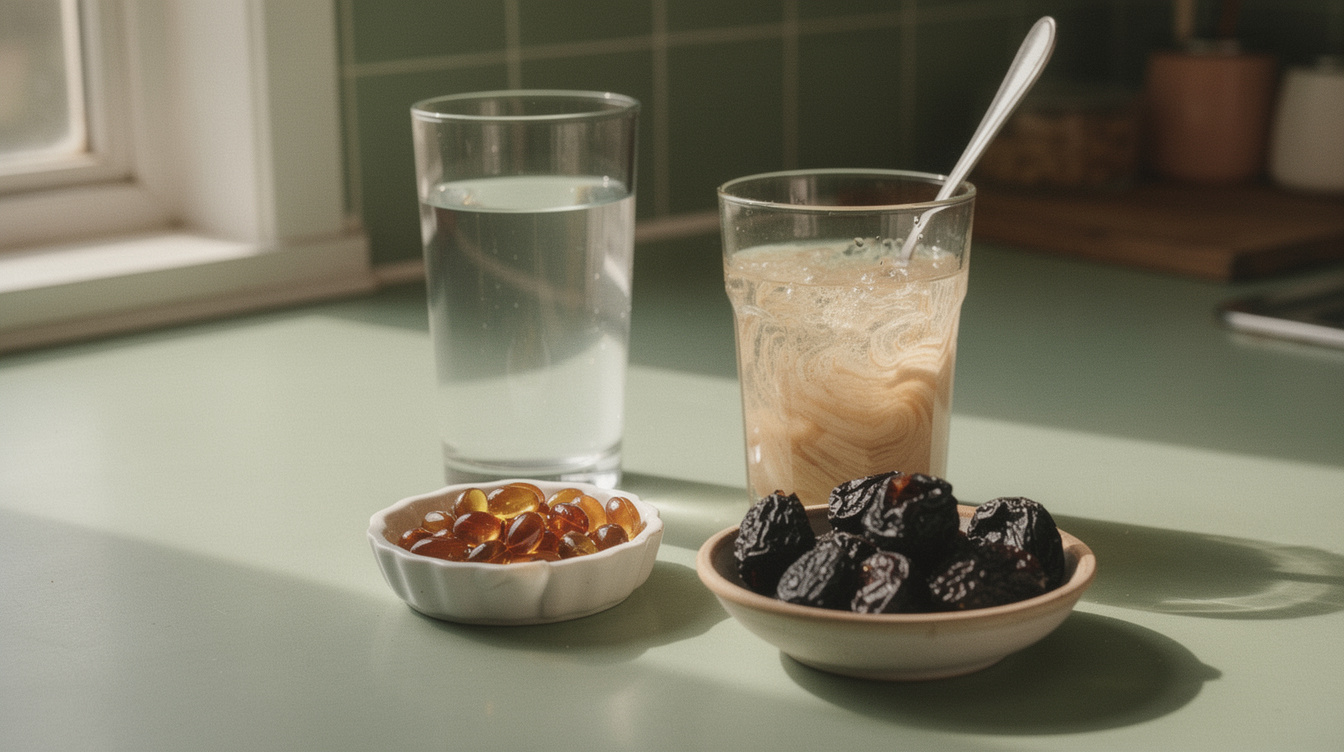
- Use a stool softener or a bulk laxative — not an enema or a stimulant. MedlinePlus is unusually direct: "Use a stool softener or bulk laxative (not enemas or stimulating laxatives)." Cleveland Clinic notes that "stool softeners are safe to use, and a very common medication women take after giving birth," and that they are nearly universally prescribed when people leave the hospital.
- Walk, even a little. MedlinePlus's C-section guide says "getting up and walking around once you are home will help you heal faster and can help prevent blood clots," and NIDDK notes that "getting regular physical activity may help relieve your symptoms." Short, flat, unambitious walks count.
- Give yourself a time of day. NIDDK suggests building a routine — "trying to have a bowel movement 15 to 45 minutes after breakfast" — because the body cooperates better with a habit than with an emergency.
- Do not ignore the urge. Waiting it out is on the Cochrane review's list of risk factors. When the feeling arrives, go, even if the timing is inconvenient and the baby is awake.
05What the evidence on laxatives really says
Here is where we have to be honest rather than tidy. Laxatives are handed out routinely after birth, but the research behind that habit is thinner than you would guess.
The Cochrane review on preventing constipation after giving birth pooled five trials covering 1,208 postpartum women — and notes that "four of the five trials were published over 40 years ago." Its verdict is blunt: "There is insufficient evidence to make general conclusions about the effectiveness and safety of laxatives for preventing postpartum constipation." The evidence overall was rated low to very low certainty.
There were two findings worth knowing anyway. Senna "may increase the number of women having their first bowel movement within 24 hours after delivery," though it may also increase abdominal cramps. And for anyone nursing, the reassuring one: "laxatives taken by the mother may have little or no effect on loose stools in the baby."
The gap nobody has studied
The reviewers also reported that they did not find a single trial testing the educational or lifestyle approaches — the diet and exercise advice every new parent is given. So when a nurse tells you to drink water, eat fruit, and take a short walk, that is sound clinical practice built on how the gut works, not on a stack of trials comparing it against doing nothing. It is still the right first move. It is just not the same kind of proof, and we would rather say so.
06If you have stitches, a tear, or hemorrhoids
This is the situation where soft stools stop being a comfort issue and start being part of your repair. Cleveland Clinic points out that stool softeners matter particularly for people with higher-grade perineal tears, specifically to avoid putting strain on the stitches. If you have stitches of any kind, that first bowel movement is not a test of toughness — pressure is the thing you are trying to avoid, so take the softener and do not push.
Hemorrhoids are the other common guest. MedlinePlus notes that hemorrhoids that developed during pregnancy gradually get better, and suggests "warm tub baths," "cold compresses over the area," over-the-counter pain relievers, and over-the-counter hemorrhoid ointments or suppositories — while advising you to check with your provider before using any suppository. NIDDK's broader hemorrhoid guidance adds the two habits that do the most good and cost nothing: avoid "straining during bowel movements," and stop "sitting on the toilet for long periods of time." Which, realistically, means the one quiet room in the house stops doubling as your phone break.
07When to call your provider
Most postpartum constipation resolves with water, fiber, movement, and a softener. A few things are worth a phone call rather than patience.
- Nothing is moving and you are worried. You do not need to hit a particular number of days to be allowed to ask. Call and describe it — including which pain medication and which supplements you are taking, since both show up on the cause list above.
- Any leaking of stool around six weeks postpartum. Cleveland Clinic says to contact your doctor about this, because it may lead to a referral for pelvic floor physical therapy. It is treatable, it is more common than people admit, and it is not something to live with quietly.
- Pain that is getting worse rather than better, or bleeding you cannot account for. Postpartum bleeding has a normal pattern, and anything outside it is a call.
- Hemorrhoid symptoms that have not improved after about a week of over-the-counter treatment. NIDDK's guidance is that most doctors recommend using those products for about a week, then checking back in if symptoms persist.
08The part that makes all of this easier
None of the advice above is hard. It is just hard to do when you have slept in ninety-minute fragments for a week and cannot remember whether you drank anything since breakfast. Water, fruit, and a short walk are easy when someone else is holding the baby and impossible when nobody is.
That is the real reason the first weeks go better with help in the house — and it is why some families bring in overnight newborn care for even a few nights, so recovery gets a few uninterrupted hours to happen in. If you are still pregnant, stocking the small stuff now takes it off the list later: our postpartum essentials guide covers what is genuinely worth having on the shelf before the birth, and the free week-by-week planner puts that kind of prep in the middle of pregnancy instead of the last exhausted stretch.
Questions parents actually ask
How long after birth will I have my first bowel movement?
It depends on how you delivered. Cleveland Clinic says that after a vaginal delivery it may not be very delayed — often within the first day or two. After a C-section the bowels take longer to wake up from major surgery, and it can take three or four days. If nothing is happening and you are worried, call your provider and tell them what pain medication and supplements you are taking.
Is postpartum constipation normal?
Very. The Cochrane review on preventing postpartum constipation reports a prevalence of 41.8% by women's own report, and 24.7% when measured against the stricter Rome clinical criteria. It also notes that about 25% of women have constipation through pregnancy and still at three months postpartum, so a long tail is common too.
Are stool softeners safe while breastfeeding?
Cleveland Clinic describes stool softeners as safe to use and a very common medication after giving birth, and they are nearly always sent home with you from the hospital. On the related worry about your baby: the Cochrane review found that laxatives taken by the mother may have little or no effect on loose stools in the baby. Check anything you take with your own provider, since they know what else you are on.
What should I eat and drink for constipation after giving birth?
MedlinePlus, the National Library of Medicine's consumer health site, tells people after both vaginal and cesarean births to eat plenty of fruits and vegetables and drink 8 cups (2 liters) of water a day to prevent constipation. For a fiber target, NIDDK says adults should get 22 to 34 grams a day depending on age and sex — and to increase liquids whenever you increase fiber.
Should I use an enema or a stimulant laxative after birth?
MedlinePlus's post-delivery instructions specifically say to use a stool softener or bulk laxative and not enemas or stimulating laxatives. NIDDK similarly reserves stimulant laxatives for cases where constipation is severe or other treatments have not worked. That is a decision to make with your provider rather than in the pharmacy aisle.
What if I have stitches from a tear or an episiotomy?
Then keeping stools soft is part of protecting the repair. Cleveland Clinic notes that stool softeners matter especially with higher-grade perineal tears, precisely to avoid putting pressure on the stitches. Take the softener, do not strain, and do not sit on the toilet for long stretches — NIDDK names both straining and long sitting as things to avoid.
Sources
- Cleveland Clinic — What To Know About Pooping After Giving Birth — First bowel movement after a vaginal delivery may not be very delayed and may happen in the first day or two; after a C-section the bowels take time to wake up and it can take three or four days; postpartum constipation causes include opioid pain medication, iron supplements after blood loss, and dehydration from breastfeeding; stool softeners are safe and a very common medication after birth and are nearly universally prescribed at discharge; stool softeners matter particularly with higher-grade perineal tears to avoid straining stitches; contact a doctor about fecal leakage around six weeks postpartum for a possible pelvic floor physical therapy referral.
- Cochrane Review (full text via NIH PMC) — Interventions for preventing postpartum constipation — Prevalence of postpartum constipation reported as 41.8% by self-report and 24.7% by Rome criteria; 25% of women have constipation throughout pregnancy and at three months postpartum; two or fewer bowel movements a week occurs in about one third of women in the third trimester; risk factors include high progesterone in pregnancy with dietary interruption, hemorrhoids causing fear of pain, episiotomy pain and perineal trauma, reduced physical activity after delivery, low-fiber diets, pain medication, and ignoring bowel urges.
- Cochrane plain-language summary — Interventions for preventing constipation after giving birth — Five trials with 1,208 postpartum women; four of the five published over 40 years ago; evidence assessed as low to very low certainty; senna may increase the number of women having a first bowel movement within 24 hours after delivery but may increase abdominal cramps; laxatives taken by the mother may have little or no effect on loose stools in the baby; insufficient evidence to make general conclusions about the effectiveness and safety of laxatives for preventing postpartum constipation; no trials of educational or lifestyle interventions were identified.
- MedlinePlus (National Library of Medicine) — Vaginal delivery: discharge instructions — Eat a high-fiber diet with plenty of fruits and vegetables; drink 8 cups (2 liters) of water a day to prevent constipation and bladder infections; use a stool softener or bulk laxative, not enemas or stimulating laxatives; hemorrhoids from pregnancy gradually decrease, with warm tub baths, cold compresses, over-the-counter pain relievers, and over-the-counter hemorrhoid ointments or suppositories suggested, checking with a provider before using suppositories.
- MedlinePlus (National Library of Medicine) — Going home after a C-section — Eat plenty of fruits and vegetables and drink 8 cups (2 liters) of water a day to keep from getting constipated; bulk laxatives to prevent constipation, asking a provider for recommendations; getting up and walking around once home helps healing and can help prevent blood clots.
- NIDDK (National Institutes of Health) — Constipation: Treatment — Adults should get 22 to 34 grams of fiber a day depending on age and sex; drink plenty of water and other liquids when increasing fiber or taking a fiber supplement; regular physical activity may help relieve symptoms; build a routine such as trying to have a bowel movement 15 to 45 minutes after breakfast; stimulant laxatives are for when constipation is severe or other treatments have not worked.
Newborn Weeks is planning help, not medical advice — always follow your own doctor, midwife, or pediatrician.
From the gear guide
- Infantino Flip Luxe 4-in-1 Carrier — our pick in baby carriers
- You+ME 4-in-1 Baby Carrier — our pick in baby carriers
- Diono Radian 3R — our pick in convertible car seats
- Baby Trend Nursery Center Playard — our pick in cribs & travel cribs
Keep reading
 Sleep · 13 min read
Newborn Day-Night Confusion: Why Your Baby Is Up All Night (and What Actually Helps)
Newborn day-night confusion is a body clock that isn't built yet. What the AAP and sleep research say actually helps, and when it ends on its own.
Read the article Feeding · 14 min read
Baby Won't Take a Bottle? What Actually Helps, Step by Step
Baby won't take a bottle? The AAP-, La Leche League- and CDC-backed fixes that help: who offers it, when, how warm the milk is, and when to call the doctor.
Read the article Pregnancy · 13 min read
The Tdap Vaccine in Pregnancy: Why It's Given at 27 to 36 Weeks
The Tdap vaccine in pregnancy is given at 27 to 36 weeks so antibodies reach your baby before birth. What the CDC says about timing and safety.
Read the article